Saturday, April 18, 2020

Hall of Famers

I just posted the Hall of Famers in the 1971 Topps set, and now it's 1968's turn.

These are the 38 Hall of Famers in the 217-player set, including 8 quarterbacks (or 7, if you believe George Blanda is in the HOF for his kicking prowess).


Re-cap: 
5 - Redskins
3 - Browns, Chiefs, Cowboys, Packers
2 - Bears, Cardinals, Chargers, Colts, Jets, Raiders
1 - Broncos, Dolphins, Eagles, Falcons, 49ers, Giants, Lions, Patriots, Saints
0 - Bengals, Bills, Oilers, Rams, Steelers, Vikings

Sunday, July 14, 2019

Philadelphia Eagles (bonus cards - part 2)

Here are the remaining 6 cards in the 1968 Eagles set produced by RetroCards.

(You can see the other 12 cards here in part 1.)
 
Lane Howell was the Eagles’ left offensive tackle from 1965-69. He was a backup with the Giants for 2 seasons, then acquired in a trade for guard Pete Case.

Mel Tom was the Eagles’ 6th-round pick in the 1966 draft. Drafted as a linebacker, he initially wore #58 until switching to #99 in 1970. After a year (I assume on the taxi-squad), he played every game from 1967 until he was traded to the Bears 4 games into the 1973 season. Mel started all but 1 game at right end from 1968 until his trade to Chicago.

Frank Molden was acquired from the Rams before the 1966 season for linebacker Maxie Baughan, but did not play in ’66 or ’67. He started 7 games at left DT in 1968, then moved on to the Giants in 1969.


Harold Wells played four years (1965-68), all with the Eagles. He played in every game, and started every game at right linebacker from 1966-68. He never had a Topps or Philly Gum card.

Except for missing all but 1 game in 1967 due to injury, Al Nelson was a starting cornerback for the Eagles from his rookie season of 1965 until midway through his final 1973 season, when he was replaced by John Outlaw. He played left corner every year but 1970.

Joe Scarpati was the Eagles’ free safety from 1964 to 1969, playing every game but two during his rookie year. He was traded to the Saints in 1970, where he started 10 games and was the holder for Tom Dempsey’s record 63-yard field goal. Joe returned to the Eagles in 1971 but was injured in training camp.

Saturday, July 13, 2019

Philadelphia Eagles (bonus cards - part 1)

In the last post, we looked at the 1968 Eagles in the Topps regular issue set. Like with most teams, there were 8 cards.

A few years ago, I stumbled upon the website for RetroCards, a company that makes (mostly football) cards in the design of sets from the 1950s to 1970s. They seem to focus mainly on Cowboys sets, but there are many sets for the Packers and Bears, as well as for some other teams (and all teams in 1963 and 1966).

There are usually between 15 and 24 cards per team set (depending on photo availability I guess). The card fronts match the original sets almost exactly, while the backs are mostly the same except for a company logo.

In the past few years I bought the 1966 Eagles, 1967 Cowboys and Packers, 1968 Packers, 1971 Cowboys, some assorted 1966 cards, and the 5-card Vince Papale set. The only discrepancy I have found among those sets is that the blue border on the 1971 cards is lighter than the original Topps cards.

This month I bought the 1968 Eagles set, and it just arrived. I am going to show these cards in two posts, for the sole reason that Blogger limits the labels to a combined length of 200 characters. This post has 12 offensive players. The next post will have the 5 defensive players, and OT Lane Howell. (If I thought ahead, I could have included Randy Beisler with the defensive group instead, since he played DT in 1968.)

What I like about this set:
1. Eighteen more 1968 Eagles cards. Yeah!
2. The only cards made for Chuck Hughes, Harry Jones, Larry Conjar, Frank Molden, and Harold Wells.
3. The only Eagles card for Randy Beisler, and the only card of Mel Tom wearing #58 (he later switched to #99).

What I don't like: 
1. The card backs are gray with red printing, making them hard to read. (The original backs were bright white with green or blue printing.)
2. No Ben Hawkins card. He was a starting WR from 1966-72, and had just led the NFL with 1265 receiving yards in 1967. It's hard to believe a photo of him wearing the 1966-69 jersey was not available.
3. Other 1968 starters left out of the Topps and RetroCards combined set are center Gene Ceppetelli, guards Dick Hart and Mark Nordquist, DE Tim Rossovich, DT Gary Pettigrew, and cornerback Alvin Haymond.

I'm not sure why Timmy Brown was included, since he was traded to the Colts in January 1968. Also, it’s odd that little-used backups Jones, Conjar and Ron Goodwin were included while the above-mentioned starters were not. I guess it was photo availability.

The bottom line is, I like this set and I hope they plan on making Eagles sets for '67, and '69 to '72.

---

King Hill is back for one more season as the Eagles' #2 quarterback.

As mentioned, Timmy Brown was traded to the Colts in January 1968 for cornerback Alvin Haymond. He was the Birds' starting halfback for a number of years, but was slowed by injuries in 1967.

Izzy Lang took over the starting halfback chores from Brown, and manned that spot in '68 and '69.


Tom Woodeshick was a backup for several seasons, then started at fullback from 1967-69.

Harry Jones was the Eagles' #1 pick in the 1967 draft, but was a complete bust, getting all of 8, 22, 1, and 13 carries in his 4 seasons with the team.

Larry Conjar was the Browns' #2 pick in 1967, and played for 3 teams in his 4 NFL seasons. He rushed for 21 yards in his only season (1968) with the Eagles.

---

Chuck Hughes was a backup wide receiver from 1967-69, before playing for the Lions in ’70 and ’71. I commend RetroCards for (no doubt) resisting the urge to include a note on the back about his in-game death in 1971.

Ron Goodwin was the starting flanker from 1963-66, then lost his job to Ben Hawkins, but stuck around as a backup for 2 more seasons.

Fred Hill was the backup tight end from 1965-71, and started 8 games there in 1968 due to Mike Ditka’s absence. Hill also started 8 games at split end in 1966.


Randy Beisler was the team's 1st-round pick in 1966, and started half the games in each of his 3 seasons with the Eagles. In 1968, those games were at defensive tackle. After the 1968 season, he was traded to the 49ers for backup quarterback George Mira. (This makes NO sense! Trade your former #1 pick for a little-used backup QB? And not a very good one at that? Meanwhile, Beisler played in EVERY game for the Niners from 1969 to 1973, and started all but one game from 1970-72, while Mira was gone after one season.)

Jim Skaggs was the Eagles' starting right guard for much of 1965-70, but missed the entire 1968 season due to injury.

Bob Brown was the Eagles' starting right tackle from 1964-68, making 3 Pro Bowls during that time. He made three more with the Rams and Raiders, on his way to the Hall of Fame in 2004.

Part 2 is here

Wednesday, July 10, 2019

Philadelphia Eagles

As promised (although more than a year late) the winners of Super Bowl LII – The Philadelphia Eagles. Here is the 1968 edition, about as far from a Super Bowl champion as you can get.

The Eagles started off the 1968 season by losing their first 11 games (by a combined score of 310-144). I don't think tanking was a thing back then, like it is in the NBA now. (The Philadelphia 76ers intentionally tanked 3 consecutive seasons, and still managed to screw it up – drafting a series of players with known injury histories. Only Joel Embid remains as a tanking prize, and he can’t stay in the lineup for extended periods. But I digress.)

The Eagles could have stayed the course with their unintentional tanking, by making it all about “playing the youngsters to see what we have to build for the future”, but noooo, they had to go and win 2 of their final 3 games, thus blowing their chance for the #1 overall draft pick in 1969 (O.J. Simpson).

Instead they settled for the 3rd pick, and chose Leroy Keyes, a running back from Purdue. Even THAT was a screw-up, as the Steelers selected Joe Greene with the very next pick. Keyes had 2 poor seasons as a running back, followed by 2 less-than-serviceable seasons as a strong safety before they finally cut him loose.


1968 was the first year Topps issued cards for NFL players since 1963, so their first series cards have old photographs for the NFL players (and presumably newer photos for AFL players). In the 2nd series, new photos are seen.


Norm Snead was the team's quarterback from 1964-1970, acquired from the Redskins in a questionable deal for Sonny Jurgensen.


Gary Ballman was acquired from the Steelers just before the 1967 season for fullback Earl Gros and guard Bruce Van Dyke. He was a starting wide receiver in '67 and '68, and the starting tight end from 1969-71.


Mike Ditka was also acquired just before the 1967 season, from the Bears for 3rd-string QB Jack Concannon. He was the starter in 1967, but spent most of 1968 either injured or suspended for his skirmishes with the coaching staff. Ditka was traded to the Cowboys before the 1969 season.


Sam Baker came over from the Cowboys in 1964, and was the kicker from 1964-69, and punter from 1964-68.


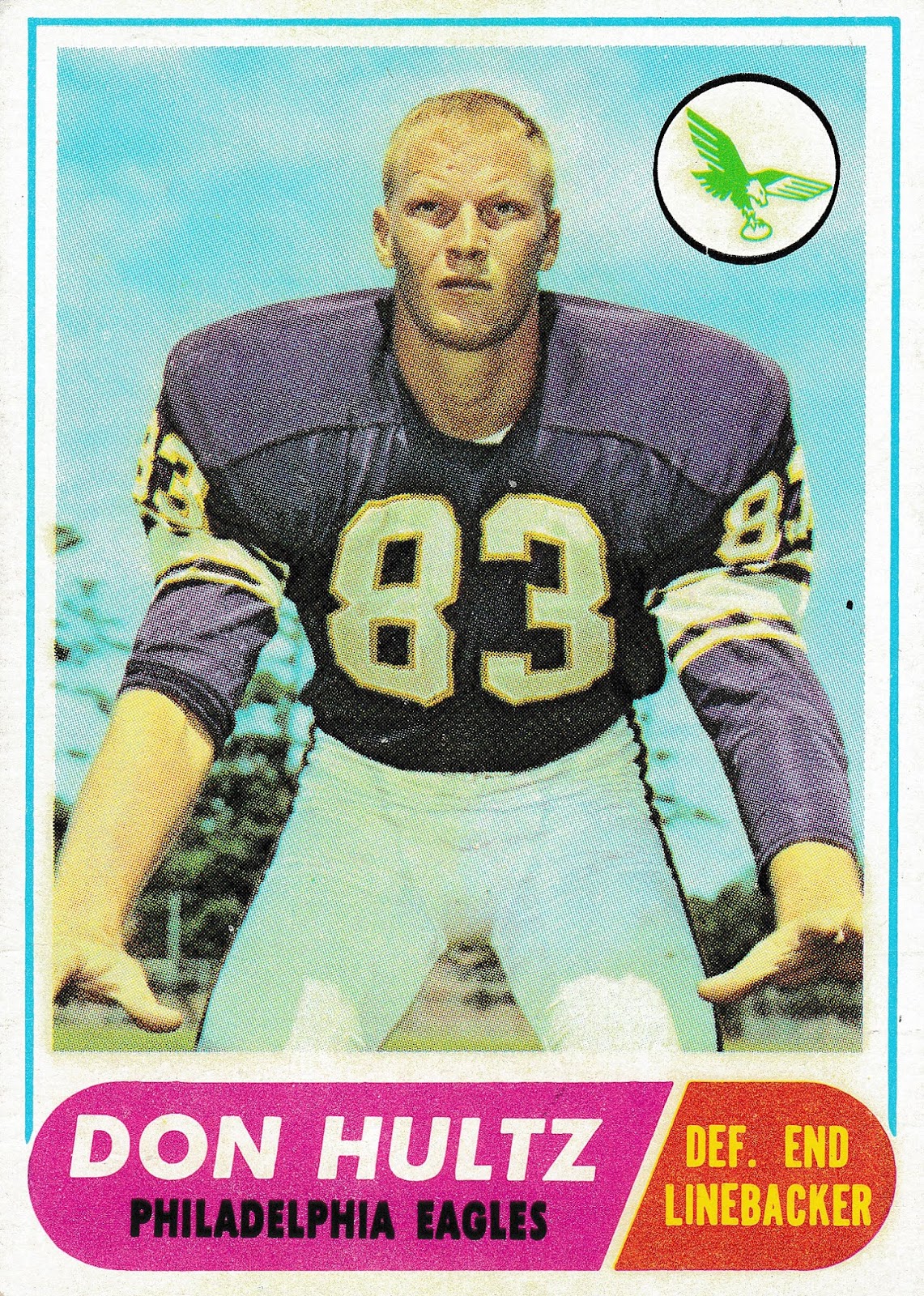
Don Hultz was acquired from the Vikings before the 1964 season, and was the starting left end from 1965-67. After 2 seasons on the bench, he was also the starting left DT from 1970-72. (There's no evidence he ever played linebacker.) After one more season on the bench, he finished up with the Bears in 1974.


After a few seasons with the Browns and Lions, Floyd Peters was the Eagles' starting left tackle from 1964-69, though missing part of 1968 with injuries. He made 3 Pro Bowls while an Eagle. Peters ended his career with the Redskins in 1970.


Like Peters, Dave Lloyd also played for the Browns and Lions before becoming an Eagle in 1963. He was the team's starting middle linebacker from 1963-69, and for the first 5 games of 1970 before he was replaced by Tim Rossovich. Dave made the Pro Bowl in his final full season (1969).


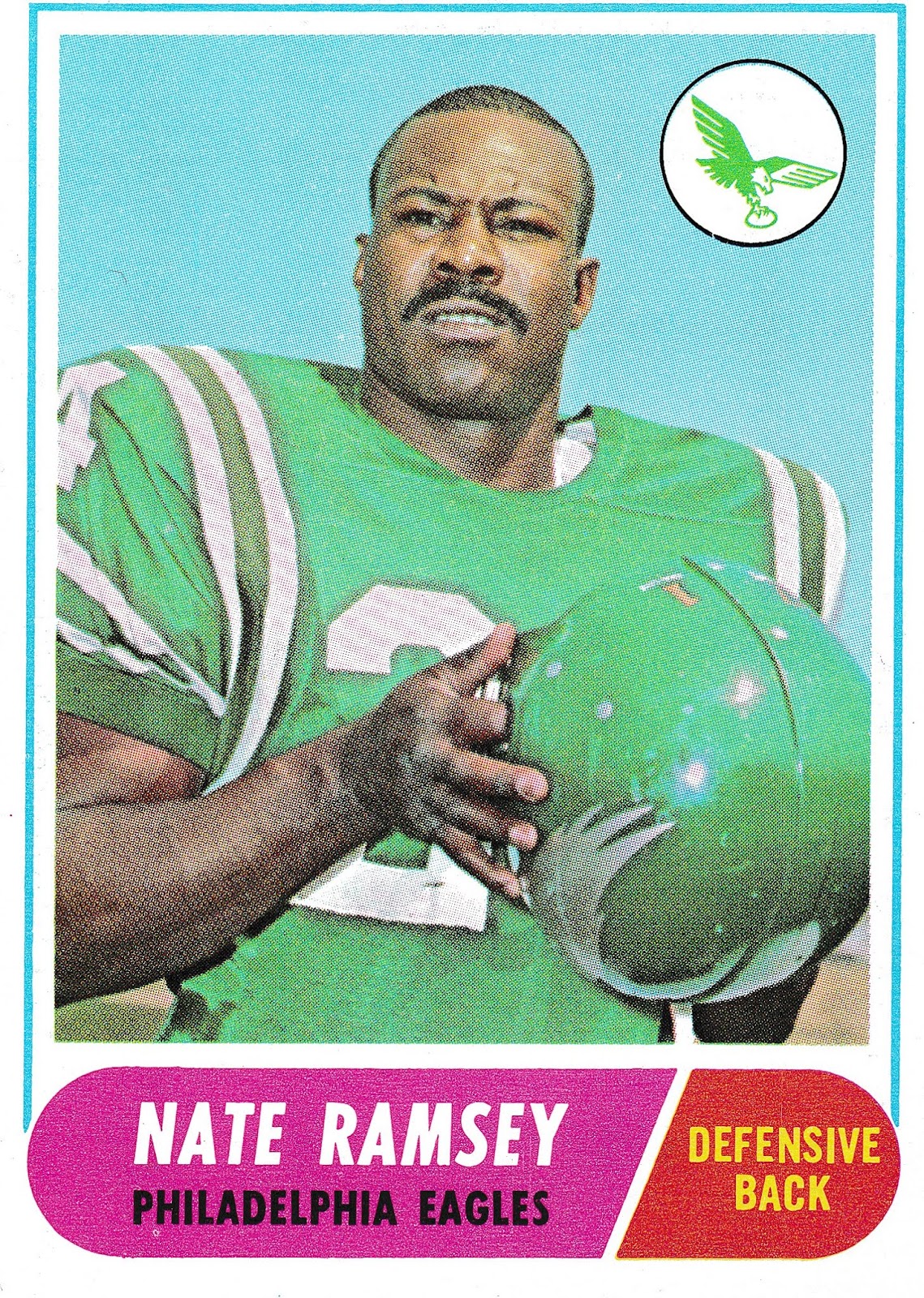
Nate Ramsey was the Eagles' 14th-round pick in 1963. He played in all but 6 games for the Eagles from 1963-72, starting about half the games in '63 and '64 as a cornerback, before moving to starting strong safety from 1965-70. He returned to cornerback for 1971-72, then played for the Saints in 1973.

Tuesday, November 1, 2016

Los Angeles Rams

Here are the cards for the 1968 Rams. Most team sets in 1968 included 8 or 9 cards. There are 12 Rams cards because 3 of them (Milt Plum, Tommy Watkins, Pat Studstill) were recently traded from the Lions to the Rams. (The Lions only have 6 cards in the set.)

The Rams were coming off an 11-1-2 season in 1967, winning their division but losing to the Packers in the playoffs. I'm not sure why the Rams made the trade for the above players, because Roman Gabriel, Les Josephson, and both starting wide receivers (Jack Snow and Bernie Casey) made the Pro Bowl in 1967. Fullback Dick Bass also rushed for 600+ yards, so it seems they didn't really need the services of Plum, Watkins, or Studstill.

In 1968 the Rams dropped to 10-3. Gabriel made the Pro Bowl again, Bass was one of the team's starting backs (with Willie Ellison replacing Josephson), and Snow and Casey each had 29 catches. Pat Studstill only caught 7 balls and was mainly used as the punter.


Roman Gabriel was the Rams' #1 pick in 1962, and was the team's starting QB from 1963 to 1972, He made the Pro Bowl from 1967-69. Traded to the Eagles after 1972, he played 5 more seasons in Philly (3 as the starter) and 1 more Pro Bowl berth.


Drafted by the Browns in 1957, Milt Plum played 11 seasons with the Browns and Lions (mostly as the #1 QB), then finished his career as a backup with the Rams in '68 and the Giants in '69. He made the Pro Bowl in '61 and '62.


Les Josephson played his entire career with the Rams (1964-74, missing the 1968 season). He was a starter every season but '66 and '74-'76, and made the 1967 Pro Bowl squad.


Dick Bass was the 2nd overall pick in 1959, and played 10 seasons in LA (7 as a starter). He made 3 Pro Bowls.


Tom Watkins played for the Browns in 1961 and the Lions from 1962-67. He was mostly a return man with the Lions, and led the NFL in punt returns and return yardage in 1963. Although part of the Lions/Rams trade after 1967, he did not play for the Rams. He played in 1 game for the Steelers in '68, then retired.


Jack Snow was drafted #1 by the Vikings in 1965, but was the Rams' starting split end from 1965 to 1974, making the Pro Bowl in 1967. He finished his career as a Rams' backup in 1975.


Bernie Casey was picked #1 by the 49ers in 1961, and after one year as a backup, he was their starting flanker for 5 seasons. He finished his career as the Rams' flanker in '67 and '68. After football, Bernie acted in dozens of movies, including the role of Felix Leiter in "Never Say Never Again".


Pat Studstill played for the Lions from 1961-67. He was a flanker and return man for his first few seasons, then exchanged his return duties for punting chores beginning in 1965. He made the Pro Bowl in '65 and '66, and led the NFL in receiving yards in 1966. Traded to the Rams after 1967, he was used mostly as a punter, only catching 7, 3, 18, and 0 balls in his 4 seasons in LA. He was the Patriots' punter in 1972, his final season.


Lamar Lundy was the right defensive end in the Rams' famed "Fearsome Foursome" defensive line. He played his entire career (1957-69) with the Rams, and was a starter from 1959-67.


Roger Brown was the starting right defensive tackle for the Lions in his first 7 seasons (1960-66), with Pro Bowl appearances in the last 5 seasons. Acquired by the Rams in 1967 to replace the retired Rosey Grier, he played 3 more seasons (2 as a starter, plus another Pro Bowl appearance).


Maxie Baughan was the Eagles' 2nd-round pick in 1960, and was a starting outside linebacker for the next 11 seasons (including 9 Pro Bowls). He played 6 seasons with the Eagles, and 5 with the Rams. He retired after the 1970 season, but was activated by the Redskins (where he was coaching) for 2 games in 1974.


Ed Meador was drafted by the Rams in 1959, and played all 12 seasons as a starting DB for them. After 5 years as a cornerback, he moved to free safety for his final 7 seasons.


Also check out the 1967 and 1971 Rams.

.